Friday, July 21, 2017

Birds in Idaho - Part I

Mountain view from Bear Lake National Wildlife Refuge, Idaho
 In the beginning of June, Dave and I took a two-week vacation out West. We flew into Salt Lake City where we rented a car which carried us approximately 2,000 miles through northeastern Utah, western Wyoming and Southern Idaho. I hope to post a few blogs that will highlight some of the wildlife we saw. I was going to post one blog on birds, but we saw so many that I will divide it into two posts. This post will focus on bird sightings in Utah and at the Bear Lake National Wildlife Refuge (NWR.) Traveling at the beginning of June was a perfect time to see a lot of different birds that were either migrating or, having reached their summer destination, were staying put to breed. I have realized that after our trip to South Dakota last year, and now this trip that I need to acquire a North American Western Region field guide as many of the birds we saw would never be found in New England.  

We were only in Utah for a little over a day, but I was still able to check off two new bird species. The first was an American Dipper, spotted along the Logan Canyon Byway. We stopped to walk along a path by the river and saw the Dipper within a few minutes. I knew right away what it was since we met a birdwatcher last year who was looking for them in Spearfish Canyon, South Dakota. This river and canyon here were very similar to Spearfish.

American Dipper (at left) dipping into the water in search of food

The American dipper is a songbird, but is unique in that it catches most of its food in fast moving streams by walking or diving underwater. He was fascinating to watch.

The second species we saw was the White Pelican. I have always associated pelicans with the ocean, but they actually spend summers on inland waters. We saw these birds on Bear Lake, which is located in both the Utah and Idaho. We spent the night on the lake in Garden City, Utah and then drove north the next morning to the Bear Lake National Wildlife Refuge (NWR) just north of the lake in Idaho.We saw the pelicans in both states.

White Pelicans with Canada Geese at Bear Lake National Wildlife Refuge, Idaho
White Pelicans are one of the largest birds in North America, with wing-spans up to nine-feet! Their large size is apparent in the photo above as the Canada Geese are dwarfed by them.

Idaho Birding Trail SE33 Bear Lake NWR
Idaho has mapped birding trails of the entire state. They also classify certain sites as "blue ribbon" sites. We were fortunate that unintentionally our travels took us by several "blue ribbon locations." The Bear Lake NWR is one of the ribbon locations site and it did not disappoint. Even before we turned onto the Refuge Entrance Road, there were different species of birds everywhere.   

This long beaked bird below appears to be a Wilson's Snipe. The Cornell Lab's website states that they like to stand on fence posts which is what this one was doing.

Wilson's Snipe
It was impossible to miss the bold color of the Yellow-Headed Blackbirds which were perched along the fences. They nest in the same habitat as red-winged blackbirds, but are larger and more dominant. Fossils of this bird have been found which date back 100,000 years.

Yellow-headed Blackbirds were common
We had still not even arrived at the refuge entrance when we saw an eagle in a farm field. It was a juvenile bald eagle, perhaps in its second year.

Juvenile bald eagle with Magpies

Later, while leaving the refuge and at approximately the same location, we thought we saw another  eagle...


However, when it turned its head we could see that it was a turkey vulture. I'm not sure why a bald eagle brings a feeling of awe, but for many a turkey vulture brings a feeling of disgust. I personally think that they are attractive in their own right.


Turkey vultures have a bald red head


Once we actually entered the refuge we started to see lots of waterbirds. Most were first time sightings for me. Below is what I believe to be a male and female Lesser Scaup. The colorings are a little different than what I have seen on-line, but the shape and description seem to match. Please correct me if I am wrong.

Lesser Scaup pair?


The American coot, although resembling a duck when swimming, does not have webbed feet and needs to "run" across water before taking flight.  Its white bill is unmistakable.

American Coot


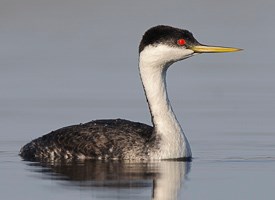
Western Grebe Photo
Western Grebe
The Western Grebe was one of the first birds we saw in the refuge and they were common throughout. Their long neck and flattish topped head, reminded me of a serpent. They have a very elaborate courting dance which  we did not get to witness.


As you can tell, many of the birds we saw were at a distance, so it was difficult to get a good picture, but due to the unique color of a particular breed, identification was not difficult - like with the Cinnamon Teal below.
Stunning Orange Teal


Adult Male
Rudy Duck
Although it is difficult to see in my photo on the left, the blue beak of the Ruddy duck made it easy to identify. Another distinguishing feature of this bird is how its tail sticks straight up in the air.

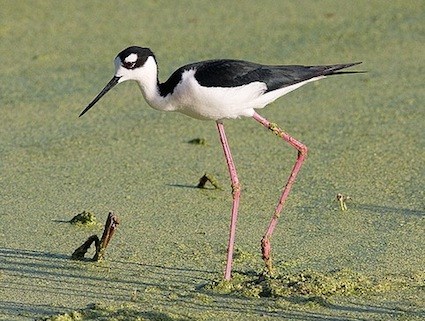
One particular wetland area was filled with hundreds of birds - most we could not identify, but these  Black-necked Stilts were easy to recognize with their red legs and a white crescent over their eye.
Black-necked Stilts in wetlands


Adult

Note: smaller photos copied from Allaboutbirds.org


I need help with the identification of this bird?


I could have stayed in the NWR all day, but alas, we needed to continue on our journey north to Wyoming and the Grand Tetons and Yellowstone National Parks. As we exited the refuge, the bird sightings were topped off with a close-up look at an inquisitive badger.

This Badger came out from hiding to check out our car.

Tuesday, July 4, 2017

It's a Monarch Caterpillar!


After years of letting milkweed plants propagate in our yard I finally found a caterpillar. It was hiding underneath a milkweed leaf and I barely saw it out of the corner of my eye. I only found one larvae which is pretty big already. I will continue to keep on eye on the area to see if I can discover where it decides to pupate.

In addition to the caterpillar, the milkweed plants were also hosting lots of beetles and honey bees.

Have a Happy Fourth of July and in addition to fireworks, don't forget to enjoy some of the inconspicuous displays of color in the garden.


Saturday, July 1, 2017

Save the Milkweed, Save the Monarchs

Common Milkweed in Bloom

A study just published in June that was supported by the U.S. Department of Agriculture, and conducted by the Monarch Conservation Science Partnership, re-confirms the importance of increasing milkweed in the landscape to restore monarch populations which have declined by over 80 percent in twenty years. 

An earlier report (April, 2017) by the U.S. Geological Survey estimated that up to 1.8 billion new milkweed plants may be needed in North America for monarch populations to recover. 

Although the June study stresses that this goal cannot be accomplished without incorporating milkweed into agriculture lands, it recognizes that participation from all sectors of society are needed. That means that we all can contribute. Although you can now purchase milkweed seeds from a variety of sources, all that is needed in many cases is to leave portions of the landscape undisturbed. On our property, milkweed plants have come back on their own and are found scattered throughout our yard. We do manage it, as it would easily take over in the garden or other areas that would be detrimental. One area that we have let it run wild is next to our compost bin. For the most part I don't have to worry about it, and strays can be easily removed before they get too large.

Milkweed, when left alone will spread readily
Although I have not discovered any monarch larvae on these milkweed plants, every year I am hopeful. Now is the time that milkweed start to bloom and will attract butterflies and other pollinators such as this bumble bee (right) this morning. 

If you do not want milkweed in your yard, the study also mentions the importance of planting a variety of native flowering plants since adult monarchs do not feed on milkweed exclusively. This will not only be good for the monarchs, but will benefit other species as well.

Wednesday, June 21, 2017

Welcome Summer and Pollinator Week

The first pollinator to our yard this spring was a tri-colored bumble bee
We just returned from a two week vacation to Utah, Wyoming and Idaho. I have not yet previewed them, but am looking forward to sharing some photos from our trip. This week has been busy with work, household and garden catch-up, but I wanted to publish a quick post since today is now the first day of summer! Check out this article on time differences for the solstice. I got most of the garden planted before we left - although I would have preferred having a couple more days for the ground to dry out completely. In addition, I received an electric fence kit for my birthday and my son and daughter-in-law helped install it.

After mulching heavily with straw, the garden fared pretty well following two weeks with no care, except occasional watering. The most exciting thing is that plants are actually growing without being devoured by deer. This is a major hurdle that has overcome. The fence is simple - polywire with a battery operated charger.

Electric polywire fence around newly planted garden
This year is an experiment, but hopefully it continues to do its job throughout the summer. Here is a photo 3 weeks after planting.


In addition to the summer solstice, we can also celebrate Pollinator Week, which was initiated by Congress ten years ago and occurs this year from June 19 - June 25. A new certification program identifies farmers that support pollinators through specific management practices and is called "Bee Better Certified." Even if you are not a garden, you can appreciate the warmth and brightness of the summer sun and the beneficial bees, insects and birds which pollinate the flowers around us resulting in fruit and vegetables we will be relishing later this summer.

Monday, June 12, 2017

Black Bean, Farro and Mango Salad

Black Bean, Farro and Mango Salad

Ingredients:
SALAD
2 cups each Kale and Romaine 
1 cup black beans
1 cup cooked farro
1 cup cubed mango
1/2 cup corn
1/2 avocado
1/2 yellow or red pepper
1 cup grape tomatoes cut in half
1 green onion chopped 
DRESSING
1/4 cup tomato salsa
2 Tablespoons lime juice
1 Tablespoon olive oil

 Make dressing and set aside. Combine the rest of the ingredients and serve over a bed of tortilla chips. Garnish with fresh cilantro and serve with dressing on the side. A light dish to serve as a meal or a side.


Friday, May 26, 2017

Birdwatching in May

Looking across the field at the Eagle Point Wildlife Management Area toward Lake Memphremagog
In my opinion the best time of year for birdwatching is during the spring migration. Not only is there the potential to see a wide variety of species, no matter what the weather, spotting a bird that has traveled hundreds, or perhaps thousands, of miles to reach its summer breeding ground is inspiring. I had the opportunity to go birding twice this morning. Two weeks ago, my son and daughter-in-law joined me and a group of New Hampshire birders early in the morning for the New Hampshire Audubon Society's annual warbler walk at Concord's Horseshoe Pond. It was a cold and damp, but any discomfort was quickly forgotten as the first bird, a yellow warbler, was spotted. The participants included several seasoned birders and one kept track of all the species that were identified and uploaded the list to the eBird website, which is sponsored by the Cornell Lab of Ornithology. It was a highly successful walk, as 51 species were identified by the group. I only saw about half that number and the documented "loon" flyover just looked like a dark speck in the sky to me. But, I keep adding to my birder's life list and each year I can recognize a few more species.

This past weekend, I visited Eagle Point in the Missisquoi Wildlife Refuge, Derby, Vermont. The refuge is comprised of 420 acres in the U.S. and an additional 420 acres adjacent to the property in Canada. The area boasts a variety of habitats including open water, wetlands, fields and woodlands. The U.S. Fish and Wildlife service has created a hiking path around the perimeter of the U.S. portion of the property, which makes it easy to explore.

Just before arriving at the parking lot, a pair of loons were skirting the shore of Lake Memphremagog. I have seen loons on the lake before, but never so close to the shore. They were just asking to be photographed.
Loons on
Lake Memphremagog
I parked my car at the second entrance off of Eagle Point Road. The open fields here provide the perfect habitat for swallows and grassland species such as the Bobolink.
Tree swallows in sumac bush
Bobolink on burdock

After crossing the field, the path continues along the Canada and United States Border with the Canadian side being mostly wooded. In this transitional area I spotted a Northern Oriole and a Northern Parula in an apple tree. Upon emerging from the Woodland loop, I saw a Northern Flicker which appeared to have been injured, but perhaps it was molting. One eye was closed and some feathers were missing from its breast. Right after that, I saw a beautiful Scarlet Tanager and a Yellow-rumped Warbler. 

Northern Flicker

Scarlet Tanager
Two and a half hours quickly passed and I returned to our condo the bird watching continued with a pair of Double-breasted Cormorants hanging out on our dock.

A pair of Double=breasted Cormorants appear engaged in conversation.
As the Memorial Weekend approaches, many, if not most, migratory birds have reached their breeding grounds. However, observations of migratory birds arrival dates is showing that they are being affected by seasonal variations as a result of climate change. This article in Scientific Reports shows that some species are making adjustments to their arrival dates, while others are not. What the long-term affects of this will be remain to be seen, but arriving to their breeding areas too soon may mean that food and shelter may not be available, which could result in dwindling populations.    


Wednesday, May 17, 2017

Quinoa and Artichoke Casserole


Finding time to post a blog is difficult this time of year, since I am outside until it gets too dark, or the bugs become intolerable. The past two weekends were rainy, which means I need to squeeze in a couple hours of yard and gardening chores each night after work. This means dinner is getting on the table much later. Casseroles are great because they can be made ahead and then simply warmed up. Young kale is available in the garden right now, which makes this recipe somewhat seasonal;  and,since the evenings are still cool, I don't mind turning on the oven.

Ingredients:
1 1/2 cups dry quinoa

1 medium onion chopped
2 cloves garlic minced
2 Tablespoons olive oil
1 1/2 cups milk
1/2 cup cream or buttermilk
1 Tablespoon cornstarch
1 jar artichoke hearts rinsed and chopped
2 cups baby spinach
2 cups chopped kale
1/2 cup parmesan cheese
3/4 cup shredded cheddar cheese
salt and pepper
-Cook quinoa in water according to package directions. Set aside. Heat 1 Tablespoon oil in large skillet and saute garlic and onion over low heat, then add artichokes. Prepare kale by massaging with 1 Tablespoon oil. Add spinach to skillet and stir just until wilted. Whisk cornstarch, salt and pepper
Heat all ingredients, except for cheese on stove
with milk, then add to skillet. Top with kale, cover and cook for about 5 minutes. Remove from heat, stir in cheeses, saving some for topping. Pour into greased 13" x 9" baking dish and top with remaining cheese. Bake at 375 degrees for 25 minutes or until set. Cool slightly, then serve warm.