Monday, December 26, 2016
Holiday Chocolate Mint Bark
When the holidays get busy, it's nice to be able to make a quick treat to serve to drop-in guests. This fool-proof candy is easy to make and can be customized with your favorite chocolate or topping. I used semi-sweet chocolate chunks and then a high quality dark chocolate candy bar. If mint isn't your thing, you could replace the peppermint extract with vanilla and top with nuts instead.
Ingredients:
12 ounces dark chocolate
1/2 teaspoon peppermint extract
Crushed peppermint candy
Line a cookie sheet with parchment paper. Melt chocolate in a double boiler, simmering over boiling water and stirring occasionally until smooth. Remove from heat. Remove from heat and beat in peppermint extract. Immediately spread thin onto parchment paper and sprinkle with crushed candy canes or other mint chips. Place in freezer 5 - 10 minutes until set. Break into pieces and store in an air-tight container.
Monday, December 19, 2016
Winter Solstice Wednesday Morning
There is so much to look forward to and celebrate in December. In addition to the special religious holidays and the farewell to the past year, one day that connects us all is the December solstice. I look forward to this day, not because it signals the official beginning to winter in the northern hemisphere, but because it marks the shortest day of the year and the gradual transition to spring, in hopefully what will seem like just a few short weeks.
Although, seasonal effective disorder is a medically established condition that can effect almost ten percent of the population in New Hampshire(1), I think that most of us can attest to being impacted by long stretches of overcast skies and winters that never seem to end - think of Stephen King's The Shining. It is the winter solstice that gives me hope because it begins the gradual transition toward longer and warmer days. Of course, for those south of the equator, the day marks the longest day of the year and the beginning of summer. This year the December solstice arrives December 21st at 10:44 in Universal Coordinated Time (UTC). You can check the time in your city at https://www.timeanddate.com/calendar/december-solstice.html.
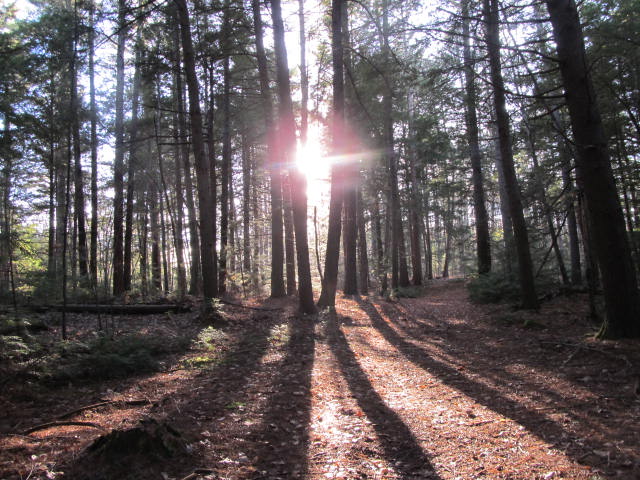
It is the time of the sunset that I seem to notice more than the sunrise and I am happy to report that last Thursday, December 15th, the sunset was its earliest at 4:11 PM. This evening, it will already be two minutes later! However, the morning sun will continue to rise later by four minutes until January 10th at which point the sun won't be setting until 4:30 PM. This is definitely cause for celebration! The picture below was taken last December as the sun was nearing the horizon. The picture would look quite different this year as we've already received over a foot of snow. But snow or not winter will arrive this Wednesday, a factor of the earth's tilt and rotation around the sun.
(1) Psychiatry (Edgemont), Jan., 2005, Katherine A. Roecklein and Kelly J. Rhoan, Seasonal Effective Disorder An Overview and Update.
Although, seasonal effective disorder is a medically established condition that can effect almost ten percent of the population in New Hampshire(1), I think that most of us can attest to being impacted by long stretches of overcast skies and winters that never seem to end - think of Stephen King's The Shining. It is the winter solstice that gives me hope because it begins the gradual transition toward longer and warmer days. Of course, for those south of the equator, the day marks the longest day of the year and the beginning of summer. This year the December solstice arrives December 21st at 10:44 in Universal Coordinated Time (UTC). You can check the time in your city at https://www.timeanddate.com/calendar/december-solstice.html.
It is the time of the sunset that I seem to notice more than the sunrise and I am happy to report that last Thursday, December 15th, the sunset was its earliest at 4:11 PM. This evening, it will already be two minutes later! However, the morning sun will continue to rise later by four minutes until January 10th at which point the sun won't be setting until 4:30 PM. This is definitely cause for celebration! The picture below was taken last December as the sun was nearing the horizon. The picture would look quite different this year as we've already received over a foot of snow. But snow or not winter will arrive this Wednesday, a factor of the earth's tilt and rotation around the sun.
| I thank the Creator for the changing seasons |
(1) Psychiatry (Edgemont), Jan., 2005, Katherine A. Roecklein and Kelly J. Rhoan, Seasonal Effective Disorder An Overview and Update.
Tuesday, December 13, 2016
Beyond Meat Expands and Tyson Foods Invests
The shift in consumer preferences away from animal based proteins due to health and environmental concerns is being responded to by marketers and has resulted in an increase of options offered at restaurants and grocery stores. In addition, it has resulted in even traditionally meat-based companies to expand their offerings. This was made apparent when it was announced this fall that Tyson Foods', one of the world's largest food companies and producer of chicken, beef and pork, had recently bought a five percent ownership in Beyond Meat, a producer of plant-based meat alternatives. When I read this report, I was curious about the Beyond Meat products and decided to check them out at our nearest Whole Foods store.
It took several employees and myself searching the store before we finally found the selections in the freezer aisle. Apparently its location had been moved several times and used to be with the refrigerated vegetarian/vegan items. I did read though that some Whole Foods stores are displaying the Beyond Burger alongside regular beef, pork and chicken.
There were beef and chicken options. We selected the Feisty Crumble which is made from a pea protein and a variety of spices. Beyond Beef resembles real beef in looks and texture although it was dryer than regular beef when cooked. To prepare, I simply heated it in a little oil until it was heated all the way through. I made a quesadilla with melted cheese and then added the leftovers to a salad along with lettuce, tomato, avocado, lime juice and cheese. Prepared this way, I almost couldn't tell the difference between this and beef hamburger.
| With a few ingredients on hand a quick meal is easy to prepare |
|
|
Tuesday, December 6, 2016
Lentil Burgers
I love finding new recipes for veggie burgers. These lentil burgers were easy to make. The jalepeno gives it a little extra kick.
Ingredients:
1 cup lentils
1/4 cup diced onion
1 clove garlic diced
1 Tablespoon oil
1/2 green pepper
1 small jalepeno seeded and chopped
2 Tablespoons tomato paste
1 teaspoon dried oregano
1/2 teaspoon cumin
1/4 teaspoon paprika
1/4 teaspoon garlic salt
1 teaspoon cilantro
2 Tablespoons flour
1 Tablespoon ground flax
1/4 cup oats
Rinse and cook lentils in boiling water, until soft, about 40 minutes. Heat oil and saute onion and garlic for five minutes. Remove from heat. When lentils are done, drain and add onions and garlic. Place half the mixture in a food processor, along with the peppers, tomato paste and spices. Add the remaining lentils, then flour and oats. Pulse until blended. Scoop and form into patties on greased cookie sheet. Mixture will be moist. Bake at 375 degrees for 30 minutes. Flip burgers, then bake for another 20 minutes at 350 degrees. Serve with your favorite toppings.
Tuesday, November 29, 2016
Unintended Consequences of Transporting Firewood
With the temperatures dipping below freezing, many of us are burning wood in fireplaces or wood stoves. The following article is written by Marcia Anderson from EPA's Greening the Apple Blog. It is a good reminder to be careful when buying, transporting and burning firewood in order to prevent the spread of destructive invasive pests.
Over the past 15 years, exotic insects like the Asian longhorned beetle, emerald ash borer (EAB), and hemlock woolly adelgid have killed millions of trees in cities and forests across the United States. Once established in new areas, these pests can quickly kill trees in our favorite forests, parks, communities, and campgrounds. The U.S. Department of Agriculture (USDA) estimates that over 30 million ash trees have already been killed by the emerald ash borer in Michigan alone, with millions dead or dying in other states (see related blog).
Firewood has been shown to be an especially troublesome means by which pests are spread. According to the USDA, the best preventative measure to protect our uninfested urban and rural forests from these pests is to limit the movement of infested materials, including firewood.
Firewood is frequently moved long distances by campers and retailers. Not surprisingly, pest infestations are showing up around campgrounds and highway rest areas. In many states, all trees used as firewood are now regulated since they have the potential to harbor invasive insects and diseases.
Firewood has historically been moved with little consideration of the pests it could be harboring. However, the issue is getting increasing attention. This year, USDA and several states put out urgent pleas to avoid transporting firewood Exit.
To protect forests and trees that are threatened by a host of invasive insects and diseases, regulation has become necessary. While regulations vary by state, they generally include restrictions on importing firewood, the movement of firewood within the state, and the transportation of firewood into state, local and federal parks.
Thirty states have imposed various levels of quarantine as a result of the emerald ash borer. In the Northeast alone, most states have restrictions on the movement of wood products. Other states, including Minnesota, Wisconsin, Michigan, Illinois, Indiana, Kentucky, Ohio, and Maryland, have also imposed regulations on the movement and importation of firewood. Some regulations do not allow the transport of wood beyond a 50-mile radius of an EAB-restricted zone. A restricted zone is the quarantine of an infested area that prohibits the movement of logs and firewood outside of the zone. Check USDA’s quarantine map before you move firewood, even to another town. Because EAB does not travel far on its own, limiting human transportation of infested material will slow its spread.
It is recommended to use locally-sourced firewood, or firewood that has been confirmed as pest free. Firewood producers and dealers must provide documentation on the source of their firewood. Note that seasoned wood alone is not an adequate treatment method because some insects can survive in untreated firewood for many months. Only firewood that is heat treated, kiln-dried (160° F for at least 75 minutes), is allowed to be brought into parks with source documentation.
Be warned that RVs and other vehicles that have been parked for long periods of time can also harbor tree pests and their eggs. If not removed prior to a road trip, these vehicles can introduce pests into a previously uninfested area. So, take the time to check your vehicle, especially the wheel wells, and remove any insects you find. You can also wash down your camper between trips to help remove any hitchhiking pests.
What is at risk from transporting these pests? The trees in your backyard, along your streets, and in your neighborhood, along with the wildlife that depend on them. In addition, jobs in the timber and forestry industries and manufacturing sector (flooring, cabinets, pallets, and even baseball bats) are impacted. A direct consequence to taxpayers are the costs borne by cities and towns to remove the hazardous trees killed by these pests.
Preventing the spread of pests is one component of an Integrated Pest Management program. Doing your part will help sustain the health of our great forest resources and neighborhood trees.
About the Author: Marcia is with EPA’s Center of Expertise for School IPM in Dallas, Texas. She holds a PhD in Environmental Management from Montclair State University along with degrees in Biology, Environmental Design, Landscape Architecture, and Instruction and Curriculum. Marcia was formerly with the EPA Region 2 Pesticides Program and has been a professor of Earth and Environmental Studies, Geology, and Oceanography at several universities.
Over the past 15 years, exotic insects like the Asian longhorned beetle, emerald ash borer (EAB), and hemlock woolly adelgid have killed millions of trees in cities and forests across the United States. Once established in new areas, these pests can quickly kill trees in our favorite forests, parks, communities, and campgrounds. The U.S. Department of Agriculture (USDA) estimates that over 30 million ash trees have already been killed by the emerald ash borer in Michigan alone, with millions dead or dying in other states (see related blog).
Firewood has been shown to be an especially troublesome means by which pests are spread. According to the USDA, the best preventative measure to protect our uninfested urban and rural forests from these pests is to limit the movement of infested materials, including firewood.
Firewood is frequently moved long distances by campers and retailers. Not surprisingly, pest infestations are showing up around campgrounds and highway rest areas. In many states, all trees used as firewood are now regulated since they have the potential to harbor invasive insects and diseases.
Firewood has historically been moved with little consideration of the pests it could be harboring. However, the issue is getting increasing attention. This year, USDA and several states put out urgent pleas to avoid transporting firewood Exit.
To protect forests and trees that are threatened by a host of invasive insects and diseases, regulation has become necessary. While regulations vary by state, they generally include restrictions on importing firewood, the movement of firewood within the state, and the transportation of firewood into state, local and federal parks.
Thirty states have imposed various levels of quarantine as a result of the emerald ash borer. In the Northeast alone, most states have restrictions on the movement of wood products. Other states, including Minnesota, Wisconsin, Michigan, Illinois, Indiana, Kentucky, Ohio, and Maryland, have also imposed regulations on the movement and importation of firewood. Some regulations do not allow the transport of wood beyond a 50-mile radius of an EAB-restricted zone. A restricted zone is the quarantine of an infested area that prohibits the movement of logs and firewood outside of the zone. Check USDA’s quarantine map before you move firewood, even to another town. Because EAB does not travel far on its own, limiting human transportation of infested material will slow its spread.
It is recommended to use locally-sourced firewood, or firewood that has been confirmed as pest free. Firewood producers and dealers must provide documentation on the source of their firewood. Note that seasoned wood alone is not an adequate treatment method because some insects can survive in untreated firewood for many months. Only firewood that is heat treated, kiln-dried (160° F for at least 75 minutes), is allowed to be brought into parks with source documentation.
Be warned that RVs and other vehicles that have been parked for long periods of time can also harbor tree pests and their eggs. If not removed prior to a road trip, these vehicles can introduce pests into a previously uninfested area. So, take the time to check your vehicle, especially the wheel wells, and remove any insects you find. You can also wash down your camper between trips to help remove any hitchhiking pests.
What is at risk from transporting these pests? The trees in your backyard, along your streets, and in your neighborhood, along with the wildlife that depend on them. In addition, jobs in the timber and forestry industries and manufacturing sector (flooring, cabinets, pallets, and even baseball bats) are impacted. A direct consequence to taxpayers are the costs borne by cities and towns to remove the hazardous trees killed by these pests.
Preventing the spread of pests is one component of an Integrated Pest Management program. Doing your part will help sustain the health of our great forest resources and neighborhood trees.
About the Author: Marcia is with EPA’s Center of Expertise for School IPM in Dallas, Texas. She holds a PhD in Environmental Management from Montclair State University along with degrees in Biology, Environmental Design, Landscape Architecture, and Instruction and Curriculum. Marcia was formerly with the EPA Region 2 Pesticides Program and has been a professor of Earth and Environmental Studies, Geology, and Oceanography at several universities.
Editor's Note:
The opinions expressed here are those of the author. They do not reflect
EPA policy, endorsement, or action, and EPA does not verify the
accuracy or science of the contents of the blog.
Wednesday, November 23, 2016
Shopping and GMO Labeling
| Clear Non-GMO labels |
As you are doing your holiday grocery shopping, you may or may not notice labels identifying whether or not an item contains genetically modified organisms (GMOs). It is encouraging that in spite of the adoption of the so called "Dark Act" this past July (Public Law 114-216) more and more products are being voluntarily labeled as Non GMO or as containing genetically engineered ingredients.
The federal law preempts any state law relating to the labeling of genetically engineered food. This included Vermont's law which had just gone into effect on July 1st. Under the federal law the Secretary of Agriculture has two years to adopt "a national mandatory bioengineered food disclosure standard." One controversial aspect of the law is that the disclosure does not have to be a text label, but can be a symbol or an electronic link. This is why the Act is known by opponents as the Dark Act. As a consumer who wants to be able to read a label and know what is in the package before buying, a link that I would have to look up later, since I do not own a Smart phone, would be useless in making a purchasing decision.
| Non-GMO Project Label |
One thing that is certain, genetically engineered food is not going away and GMO labeling is one way of providing information to the consumer on the source of their food, which is always a good thing.
Monday, November 14, 2016
Sausage, Mushroom and Rice Stuffing
This rice dish is perfect for stuffing small pumpkins or squash. It can also be served as a meal unto itself. The maple syrup makes this creamy rice dish super sweet and delicious.
Ingredients:
2 to 4 small sugar pumpkins
8 oz sweet sausage
1 Tablespoons olive oil
1 onion chopped
2 cloves garlic minced
8 oz sliced mushrooms
2 cups cooked rice
1/2 cup fresh Parmesan cheese
1/4 teaspoon thyme; 1/4 teaspoon sage
salt and pepper
1/4 cup fresh parsley
2 eggs beaten
2 Tablespoons maple syrup
Cut tops of pumpkin and scoop out seeds. Remove top and bake at 375 degrees upside down in a pan with about an inch of water for 45 minutes. Remove from oven. While pumpkin is cooking, brown sausage with onion and garlic. Add mushrooms and cook until soft. Stir in rice and spices. Add beaten eggs and maple syrup and stir in cheese, saving some for topping. Stuff pumpkin with rice filling, top with cheese. Extra can be baked in a casserole dish. Bake for 45 minutes to an hour until pumpkin is cooked. Serve whole or cut in half.
Ingredients:
2 to 4 small sugar pumpkins
8 oz sweet sausage
1 Tablespoons olive oil
1 onion chopped
2 cloves garlic minced
8 oz sliced mushrooms
2 cups cooked rice
1/2 cup fresh Parmesan cheese
1/4 teaspoon thyme; 1/4 teaspoon sage
salt and pepper
1/4 cup fresh parsley
2 eggs beaten
2 Tablespoons maple syrup
Cut tops of pumpkin and scoop out seeds. Remove top and bake at 375 degrees upside down in a pan with about an inch of water for 45 minutes. Remove from oven. While pumpkin is cooking, brown sausage with onion and garlic. Add mushrooms and cook until soft. Stir in rice and spices. Add beaten eggs and maple syrup and stir in cheese, saving some for topping. Stuff pumpkin with rice filling, top with cheese. Extra can be baked in a casserole dish. Bake for 45 minutes to an hour until pumpkin is cooked. Serve whole or cut in half.
| Sausage, mushroom and rice stuffing |
Subscribe to:
Posts (Atom)