Tuesday, February 24, 2015

Eagles, Eagles, Everywhere!

During the months of January and February, I frequently drive over to the Merrimack River looking for open water and bald eagles. They are easier to spot during this time of year because instead of having to search an entire river, you can focus your attention on areas of open water where they tend to settle and feed. There are several good winter viewing spots in New Hampshire, including the southern portion of the Merrimack River.

Can you spot the eagles?
On Saturday I was fortunate to see an adult eagle perched in a tree near the Merrimack Station Power Plant. There is usually open water at this location and I have seen eagles here on numerous occasions. I returned to this spot on Sunday around noon and knew that I was in luck again when another person was standing alongside the road taking photos. When I approached, he pointed out four juvenile eagles circling over the river. He said that he had been watching them for awhile. I typically only see one, maybe two eagles at a time, so was thrilled by this experience. After a short time, the birds flew out of sight. The photographer told me that he had previously spotted eagles on the ice near the boat ramp just a short distance down River Road. We both ended up driving there hoping to see where the birds had flown. I could not believe my eyes when I got out of the car. What looks like seed pods on a bush in the picture above, were actually five eagles sunning themselves in the top of a tree. One kept spreading its wings, seemingly enjoying the warmth of the mid-thirties degree temperature.

One adult and four immature bald eagles enjoying a mild February day.

As if this sighting wasn't exciting enough, up in the sky were several more eagles. At one point, I spotted an additional eight eagles with my binoculars, bringing the total to thirteen! I wished I still had my 35 mm camera with its zoom lens, since my convenient pocket size Canon PowerShot SX130 couldn't quite capture the birds flying above. If you look closely, though, in the picture below, you can see a few of the eagles flying above those in the tree. 


In 2007 the bald eagle was removed from the Federal list of endangered and threatened species. The record number of birds sighted in New Hampshire during the Audubon Society's 2015 Mid-Winter Bald Eagle Survey is evidence of our national symbol's successful recovery. A total of ninety birds were recorded over a two week period in January. This is amazing, considering that just a decade earlier, the number of eagles sighted was less than 40. Maybe 2015 will also bring more eagles successfully breeding in New Hampshire. In 2013 the first successful hatch of a chick along the Merrimack River in New Hampshire was documented. If you are interested in learning more about bald eagles in New Hampshire, including reports on 2015 nesting activity, visit NHAudubon.org

Friday, February 20, 2015

Baked Ziti and Cheese with Sweet Potatoes

It is definitely still winter outside and perfect weather for making all varieties of macaroni and cheese. This is a great comfort dish that uses sweet potatoes which can still be obtained locally at winter farmer's markets. The Fontina and Swiss cheese combination is creamy and delightful.


Baked Ziti and Cheese with Sweet Potatoes
2 cups Ziti
1 1/2 cups sweet potato peeled and cubed
3 Tablespoons olive oil
1 teaspoon dried thyme
Salt and pepper
1 1/2 cups spinach
1 1/4 cups milk
1/2 cup cream
1 cup shredded Fontina cheese
4 wedges of Laughing cow Swiss cheese
1/4 cup shredded Parmesan
1/8 teaspoon nutmeg
2 Tablespoons butter 
2 Tablespoons flour
Preheat oven to 400 degrees. Cook pasta until al dente. Drain and set aside. Mix thyme with olive oil and 1/2 teaspoon salt. Toss in sweet potatoes, then spread onto cookies sheet and bake 20 minutes, stirring once. Chop spinach and saute in 1 tablespoon oil until slightly wilted.
Microwave milk mixed with cream until warm. Melt butter. Mix in flour and stir until thickened. Gradually add milk and whisk until it starts to thicken. Then add 1/2 of Fontina and Swiss cheese wedges. Mix cheese mixture with pasta. Add spinach. In greased large casserole dish add have of pasta mixture, then a layer of cheeses. Add remaining pasta and remaining cheese. Add additional cream if necessary.
Bake covered at 350 degrees for 25-30 minutes until bubbly.  Serves four.

Tuesday, February 17, 2015

Environmental Advocates File for Stay Against EPA's Approval of Enlist Duo Herbicide

In October, 2014 EPA approved the registration of Dow Chemical's Enlist Duo, an herbicide combination of Glyphosate and 2,4,-D. See October 16, 2014 post:
http://www.ngnaturally.blogspot.com/2014/10/epa-approves-registration-of-dow.html#links.

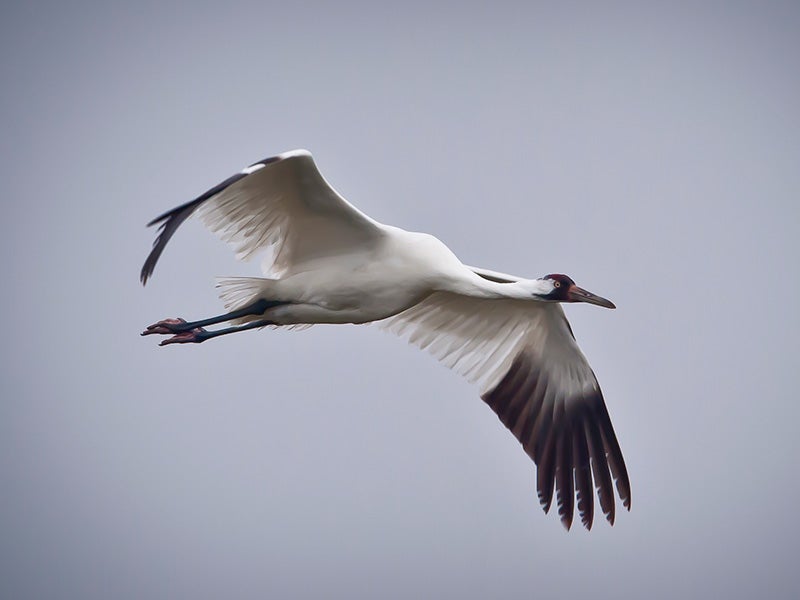
The latest lawsuit, filed February 6th in the U.S. Court of Appeals for the Ninth Circuit, requests a stay on EPA's decision. The petitioners claim that EPA violated the Endangered Species Act by failing to contact the U.S. Fish and Wildlife Service on the impacts of the use of the new herbicide combination on two critically endangered species, the whooping crane and the Indiana bat.
The whooping crane is one of the most endangered animals on earth.
Whooping Crane in Flight (John Noll, U.S. Fish and Wildlife Service)


According to the lawsuit, Although EPA did acknowledge that the herbicide may impact species listed as endangered, and identified specifically the whooping crane and Indiana bat, it did not request a formal or informal review by the Fish and Wildlife Service (FWS), but instead relied on its own assessment of risk and determined there would be "'no effect' on any listed species or designated critical habitat." EPA's determination did not follow the strict standard required by the Endangered Species Act to consult with the FWS. Since commercial use of Enlist Duo in six states is scheduled to begin this spring, the lawsuit is requesting a stay on EPA's registration pending a determination on whether their approval decision violated Section 7 of the Endangered Species Act.

Sunday, February 15, 2015

Walden Pond Visited


I recently finished reading Walden, the 150th Anniversary Illustrated edition which I checked out from the library. We had visited Walden Pond in Concord, Massachusetts a number of years ago, but I knew that I had to go back and see the sites where the photos in the book had been taken. Our prior trip had been in the summer, when the beach was awash with locals as well as tourists. I read that in July and August over 200,000 people will visit the park. For anyone contemplating this trip, I highly recommend going in the winter, where the solitude of this not so remote pond can be better appreciated.

Snowshoes made the trip around the pond easier, and in some of the lesser traveled areas a necessity


I began the walk in a counter clockwise direction. Here the path was well worn as it is the most direct route to the site of Thoreau's cabin.  After a short detour up the Ridge Path, I returned to the Pond Path which passes Wyman Meadow and what is now named Thoreau's Cove. At this point there is a well-marked sign pointing the way to the cabin site. 


The path then turns through the woods and climbs up a short hill.


As I reached the top, I could see that I was not the only one here. There was still a sense of tranquility as people photographed the granite foundation markers, or just rested in the comfort of the snow. We were all here for the same reason.


Henry David Thoreau was only twenty-eight when he built his cabin and decided to live alone in the woods for two years. In Walden he wrote "I am convinced, both by faith and experience, that to maintain one's self on this earth is not a hardship but a pastime, if we will live simply and wisely". By moving to Walden Pond he was able to live simply and thus became better connected to himself and the natural world.

Turning 180 degrees from the foundation markers there is a clear view of Walden Pond through the trees.


As I was leaving the site, I saw a family that had just crossed the pond, pulling their children on a sled. I assume they were planning on visiting the cabin site as well. 

I continued my counter clockwise walk around the pond, taking the Alternate Pond Loop which was less traveled.
There is nothing extraordinary about this place, which is in fact, what makes it so special. There are no mountains to climb and no spectacular views, so I found myself taking more time to appreciate the simplicity of nature, such as a tree trunk covered in snow.


It looks like this tree has provided many meals for woodpeckers
I welcome corrections to my guesses on the fungi and lichen in the pictures below. I definitely need to get an identification book.

Toothed polypore?
Old Man in Tree
         

Shield Lichen?
Turkey Tail Fungi?
As I descended back down to the main path, the snow was quite deep and I appreciated my snowshoes.


A little later, I heard a rumbling. I initially thought it was a truck on the nearby highway, but then I saw that it was the commuter train from Fitchburg to Boston. Unlike Thoreau who bemoaned the railroad and its desire to keep expanding across the country, my heart skipped a beat when I saw the train, thinking how special it is to have withstood the test of time and still be running over 150 years later.  


The Massachusetts Department of Conservation and Recreation has installed a wire fence around the entire shoreline to control erosion. The rust and the plants that have grown around it show that it has been here for some time and has now become part of the view. I was thinking to myself about the thousands of people that have walked this path and that there is probably probably nothing that I was seeing that had not already been observed or photographed by someone else; when, I saw something dark in the snow up ahead.


As I got closer I saw that it was a vole that had stopped to eat some seeds from a plant it must have dug up.  I could not have been more excited than if I had seen a moose. It reminded me that Nature can always surprise and that I was the only person standing here at this point in time and capturing this special moment.


As I walked across the lake back to the parking area I was completely alone and thought about the words that the clerk in the Shop at Walden Pond had said to me when I asked if I could walk onto the lake. "Well, just remember that it is over one hundred feet deep and that no one will be looking for you if you fall in." I decided to take my chances.


Wednesday, February 11, 2015

Crocodiles Just Wanna have Fun, Too


University of Tennessee study: Crocodiles just wanna have fun, too | EurekAlert! Science News

I don't typically think of reptiles as playful creatures, but this study reported that even crocodiles enjoy and thrive on interactions with other crocodiles and even animals of different species. Nature never ceases to amaze!

Sunday, February 8, 2015

February Focuses on Birds


A recent study published in Ecology Letters concluded that in the span of less than three decades, between 1980 and 2009, the bird population in twenty-five countries in Europe declined by more than 20 percent or about 420 million birds.  It would be surprising if anyone is not concerned about this statistic. The study also observed that larger species are actually increasing so that the total biomass of bird populations only fell by 7.6 percent. Although not as flashy as a statistic, 90 percent of the observed decline, or roughly 378 million birds, were from more common species. This is a concern, since it may easier to rally support around unique birds such as the peregrine falcon or bald eagle compared to the house sparrow. Although conservation efforts have increased to protect species that may be endangered, the publication stressed that  protection efforts need to be more encompassing, as declines among common species, such as the house sparrow, can have broad ramifications on the greater ecosystem. For links to various bird organizations and avian related resources visit BirdStars.Org.


One way in which the public can help is to participate in monitoring efforts. An upcoming opportunity is the Great Backyard Bird Count. This program was started in 1998 by the Cornell Lab of Ornithology and the National Audubon Society. Today it boasts numerous international partners and has participants from 135 countries. It takes place this year from February 13 - 16.  The internet has made participation convenient for anyone. The process is quite simple and the time commitment can be as little as 15 minutes. Go to http://gbbc.birdcount.org/ for further information and to register.

February is also National Bird Feeding Month, which was first announced in 1994 by a congressional declaration.

The thick snow cover in February makes it difficult for wildlife, including birds to find food.
There is a National Bird-Feeding Society and you can visit their Facebook Page at https://www.facebook.com/birdfeedingsociety. They used to have their own web-site, but that has been deactivated. The purpose of the National Bird Feeding Society is to provide outreach and education about responsible bird-feeding. It is important that seed and feeders remain clean. Discard any moldy seed and make sure feeders have proper drainage. If you provide a water source, it is important to add fresh water daily.  Make sure that there is plenty of cover near the feeder so that the birds have a place to quickly go to escape from predators. Keep feeders at least fifteen feet away from your house. Although it is cool to have window feeders for close viewing, windows are an attractive hazard for birds. We learned this the hard way this winter, when a bird flew into our glass slider and died. If you set out feeders in the winter, it is important to keep them filled regularly as birds will come to rely on them as a part of their daily diet. And finally, when spring comes, and with it the availability of plants and insects, remove the feeders to avoid unwelcome encounters with larger mammals, such as bears.

March 9, 2015 GBBC Update: Participants from more than 100 countries submitted a record 147,265 checklists, and reported 5090 species – nearly half the world’s bird species! A summary of the 2015 results can be found on the GBBC website: http://gbbc.birdcount.org/2015-gbbc-summary/

Wednesday, February 4, 2015

Adzuki Beans and Squash


Adzuki Beans, said to bring good luck in China, are rich in fiber, protein and folic acid, and are relatively low in calories. They are a great addition to your legume recipes. The recipe below is very filling; and, when served with a salad, makes a complete meal.

Ingredients:
2 cups dried adzuki beans, rinsed and soaked overnight
1 can diced tomatoes
1/2 butternut or other winter squash, peeled and diced
3 cloves garlic
2 cup chicken broth
1 medium onion chopped
1 Jalapeno or chili pepper minced
1 teaspoon salt
olive oil
1/2 teaspoon cinnamon
1/2 teaspoon crushed coriander
-Bring beans to boil and simmer about an hour until tender. Steam squash until softened. In a large pan heat oil and saute onion, garlic and pepper for about 5 minutes. Add cooked squash to onion mixture along with 1 cup of chicken broth and spices. Simmer slowly. When beans are done, add to pan along with additional broth. Heat through and serve.